
Safe Passage in the Stars: The Next Bretton Woods
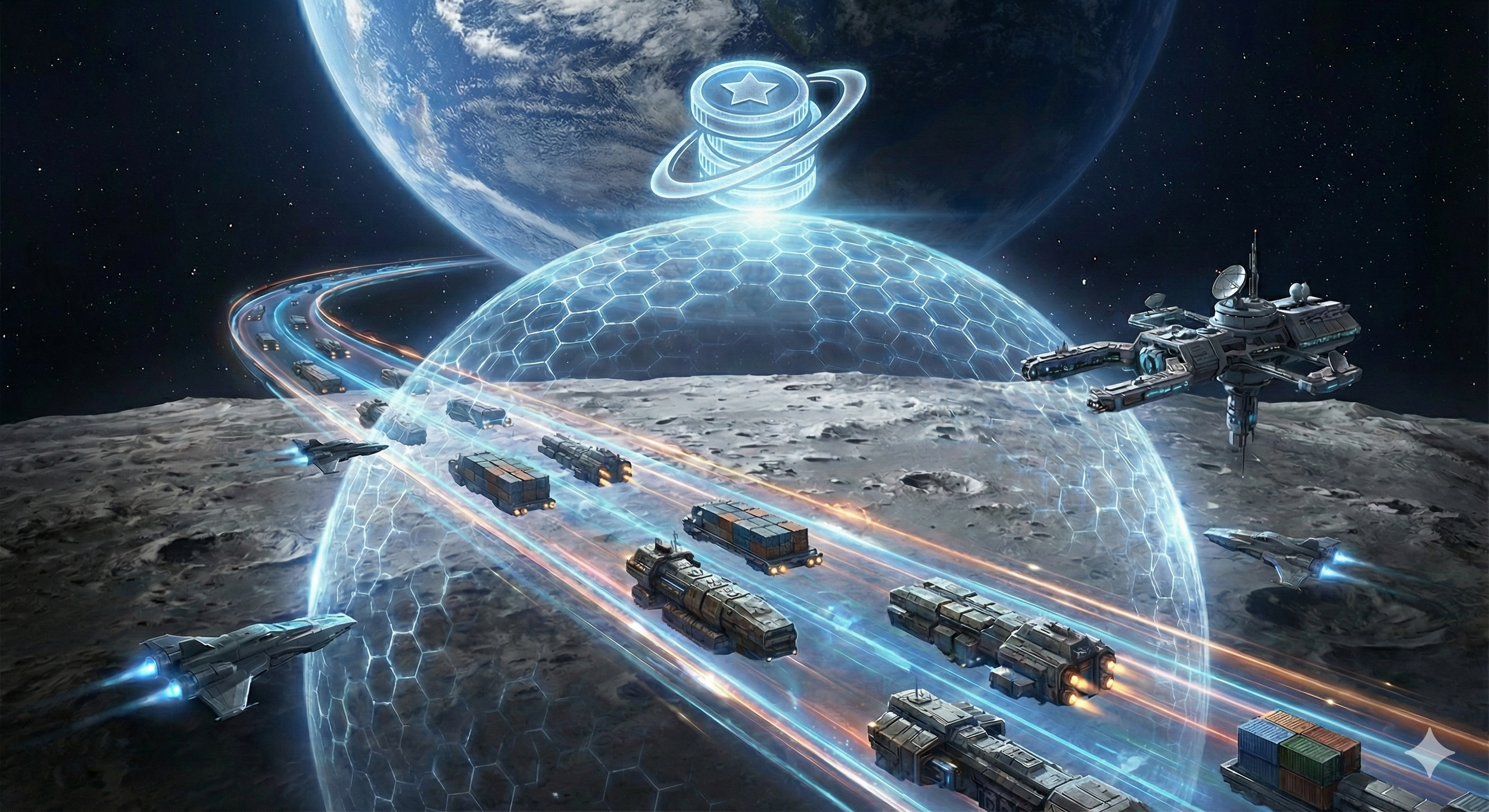
Image generated through Google Gemini (https://gemini.google.com/app)
“Whoever commands the sea commands the trade; whoever commands the trade of the world commands the riches of the world, and consequently the world itself.”
***Dedicated to the loving memory of my maternal grandmother, who taught me that strength comes from perseverance.***
Even during the Age of Exploration, Sir Raleigh understood one of the major factors of global influence: control of vital maritime trade routes. More than four hundred years later, this fact still rings true. With the Houthis Red Sea shipping attacks in 2023 and 2024 leading to supply chain disruptions, shipping delays, and insurance rate spikes, they reminded the world just how vital these trade routes remain for the global economy.
Recently, this event led myself to think about a newer (and infinitely larger) ocean that will eventually open above us: Outer Space. And just as the British Navy’s protection of sea lanes made the pound sterling the world’s standard in the 19th century, and the U.S. Navy’s stewardship of this global commons cemented the U.S. dollar’s dominance in the 20th, I believe the late 21st century and beyond will prove that whoever can secure and dominate the trade routes of Outer Space will mint the reserve currency of our solar system.
The Historical Blueprint: Trade Follows the Steward’s Flag
To understand the currency component of this future space economy, it is useful to examine the history of its close cousin back on Earth: the maritime economy. While the Bretton Woods system established the U.S. dollar as today’s global reserve currency, I believe this elite status has been maintained on the back of U.S. Navy’s role as a protector and guarantor of safe and efficient maritime trade across the globe.
When a merchant ship traverses international waters, whether through the Gulf of Aden or the Red Sea, it travels through waters primarily protected by American assets. This security creates stability, and stability creates trust. This trust, according to a paper by Professors Pierre Yared and Carolin Plfueger, then creates the belief that the guarantor will most likely prevail in conflicts on the high seas.
With approximately 80% of international trade dependent on maritime routes, this belief in U.S. naval strength preserves the value of the U.S. dollar as the primary medium of exchange for global trade. With international trade denominated in U.S. dollars, this further solidifies the currency’s preeminent status on the global stage. In this way, the legitimacy of the U.S. dollar as the global reserve currency is strengthened through the “safety premium” that its navy generates.
Defining the Space Lanes
Now, let’s imagine this same scenario applied not to Earth’s oceans but to the space above us. Although Outer Space might appear to be a vast and open expanse where spacecrafts can take any route, I argue that this arena will eventually develop well-defined space lanes for trade—very much like the sea lanes on Earth.
My belief here is informed by the laws of orbital mechanics. Just as ships funnel through specific straits and channels, spaceships will likely do the same to take advantage of pathways that are energetically efficient. This will ensure that transportation across vast distances remains economically viable. In fact, scientists have already mapped out a system called “InterPlanetary Superhighway” that allows for low-energy transits across the solar system.
Within this system, specific locations will become critical and likely establish themselves as trade outposts. For instance, for any two orbital bodies, the Lagrange Points 4 and 5 are stable equilibrium points that can serve as staging areas where spacecrafts can “park” with minimal fuel consumption for “stationkeeping.” Instead of geography, the laws of physics make these locations as strategically important as the seaports of Shanghai and Singapore. Furthermore, as Low Earth Orbits become increasingly crowded, establishing a presence at specific optimal inclinations for commercial outposts and space stations could become as competitive as securing prime ports of access or beachfront properties on Earth.
Once operational, whoever can provide security and stability for these locations and routes will essentially control the logistics of the entire solar system’s trading network. Therefore, I believe that if you can monitor, service, and defend the activities at these nodes, you don’t just enable space-based commerce, you set the terms of it.
The Currency of the Vacuum
So how would an entity’s control over the space lanes lead to that entity establishing reserve status for its currency across the solar system? I believe the answer lies not in any explicit mandate, but in the infrastructure that security requires.
Consider the practical demands of protecting space commerce. A spacefaring power that patrols the trade routes can’t simply deploy warships and call it a day. Effective security requires a comprehensive ecosystem: communication relay networks for real-time coordination, refueling depots to extend patrol range, search-and-rescue capabilities, debris tracking systems, and navigational beacons. These are not optional amenities, they are the preconditions for projecting power across the vastness of Outer Space.
But this security infrastructure can also double up as commercial infrastructure. The same communication relays that coordinate patrol vessels can also carry commercial transmissions. The same refueling depots that service military spaceships can also service cargo starships. The same rescue capabilities that recover distressed naval personnel can also save stranded space passengers. The protector of the space lanes, by necessity, becomes the operator of the space lanes.
Now imagine a lunar mining operation extracting water-ice for rocket fuel. That company faces a massive logistical burden: insuring its extraction equipment, booking transit windows through congested orbital lanes, securing its communication relays, guaranteeing cargo delivery to Earth, and shipping refined fuel to a Lagrange Point 4 or 5 depot for transfer to Mars-bound vessels. Every one of these activities requires access to the infrastructure that the space lanes protector has built.
To access that infrastructure, the mining company likely will enter into contracts; and those contracts will need to be enforceable somewhere. Here, it’s likely that these contracts will be governed by the legal system of whoever controls the physical assets as a matter of convenience. If the protector’s courts adjudicate disputes over docking rights, if the protector’s regulatory agencies certify cargo manifests, if the protector’s rescue services are the ones who respond when something goes wrong, then the entire architecture of commerce in Outer Space becomes anchored in the guardian’s jurisdiction.
Insurance should follow naturally. Underwriters need confidence that claims can be enforced, which means policies will be written under the protector’s legal framework and denominated in its currency. Banking follows insurance: if payouts, premiums, and contract settlements all flow through institutions in the protector’s jurisdiction, then maintaining accounts there becomes a practical necessity. Thus, the financial foundations of this economy will all cluster around the protector’s currency.
This is not a toll, but it can create the same result. The U.S. Navy does not invoice container ships today, and the guardian of the space lanes likely won’t either. The mechanism here is subtle: to participate in space commerce, you must plug into the protector’s financial and legal infrastructure. And once you are plugged in, holding reserves in any other currency introduces exchange rate risk. In this environment, the protector’s currency becomes the path of least resistance and then, through network effects, the only rational choice.
This is how security transforms into monetary power: not through decree but through the accumulated weight of a series of small but practical decisions, each one favoring the currency backed by the entity capable of guaranteeing that space trade happens at all.
The Outer Space Bretton Woods
Although Outer Space can’t be owned by any single nation and theoretically subscribes to the same freedom of navigation that exists on the high seas, the early days of these trade routes will likely be as unruly and dangerous as the sea lanes were during the “Golden Age of Piracy.” But eventually, order will emerge, and a protector, or an alliance of protectors, will rise.
I fully acknowledge that it may be a century or two before we see a thriving solar system filled with bustling trade routes, so this might remain a thought exercise for several generations. But when that day arrives, I believe that no matter what diplomats agree upon in conference rooms—on Earth or in space—the outcome of Outer Space’s Bretton Woods will depend on which nation’s space force is capable of securing the channels of commerce across the solar system. With that security will come power: human civilizations across the solar system will likely have no choice but to hold that power’s currency in reserve as a means of economic survival.
The emergence of this reserve currency won't be limited to physical goods. Space commerce will require new banking rails as well. Because of significant communication lags and the tyranny of the rocket equation, we won't be shipping physical cash or gold bars among planets; the currency for Outer Space will need to be transacted through weightless, digital means.
This creates a second layer of leverage for the space lanes protector. The entity that secures the shipping lanes will likely be the same entity securing the communication relays needed to provide low-latency transmission service, uninterrupted connectivity, and cryptographic verification. If a single power, or an alliance of nations, guarantees both the safety of trade spaceships and the integrity of the digital signals that pay for space commerce, its currency builds an intractable moat. With physical security and network security reinforcing each other, the “Purse of the Protector” becomes the only logical choice for the stars.
The Coming Competition
While Sir Raleigh’s observation is more than four centuries old—originating in a time when “Outer Space” as a concept had not yet emerged—the physics of power and influence remains unchanged. When we move from a maritime economy to a cosmic one, we are merely replacing wooden hulls with pressure vessels and a saltwater sea with a darker, colder vacuum. Yet in this new universe, a fundamental truth persists: security is prosperity.
Just like routes across the seven seas, the pathways of Outer Space will be built from scratch. But the stakes will be just as high as before: the nation that can guarantee safe passage through the void will not merely collect transit fees or shape trade routes, it will determine the monetary architecture for humanity’s expansion beyond Earth. An architecture that might remain in place for centuries. The nation that guarantees safe passage to the stars will not only write the de facto laws of the void, but its currency will form the connective tissue that lays the foundation for Outer Space’s development and evolution.
And so while exploration will always bring a country glory, history suggests that more permanent influence in Outer Space will not be decided by who reaches where first or who plants the most flags. The Spanish Empire claimed vast territories during the Age of Exploration but lost monetary dominance to the Dutch who controlled the sea lanes and the banking mechanisms of trade. The Soviet Union reached Outer Space first, but that early lead did not translate into economic staying power. What the course of human civilization has shown us is that territorial claims are inspiring theater, but transit control is enduring power.
Therefore, if the ultimate objective for a country in Outer Space is lasting and multigenerational influence, then I believe the strategy isn’t just a myopic focus on planting flags first on distant rocks. Instead, it is to become the entity that others trust to keep the “roads” open between here and there. That trust, denominated in whatever currency the protector uses, will eventually forge the monetary foundation for the Outer Space economy to come.