
The SLS Saga: Artemis II and the Pivot to the Possible
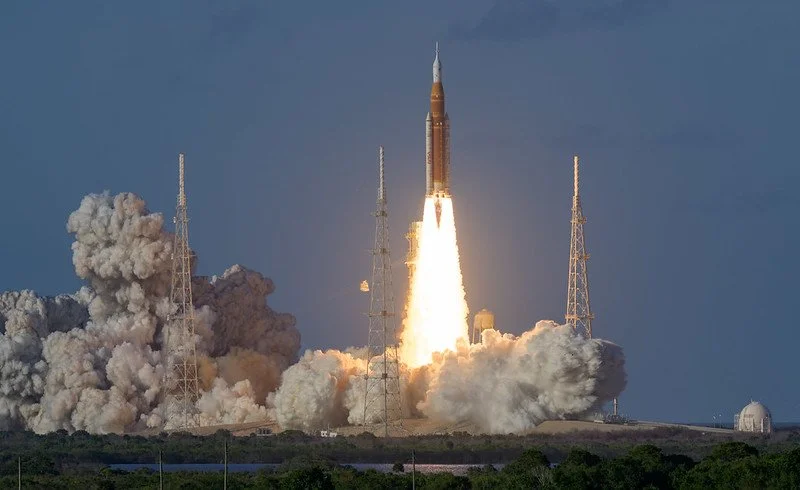
Artemis II blasting off (Courtesy of NASA)
“The best is the enemy of the good.”
***A special edition of the SLS Saga on the occasion of the Artemis II launch, the first crewed flight of the Artemis Program. For additional posts, please visit the SLS Saga microsite here***
As I write this, Artemis II has just launched. On April 1, 2026 (a date that feels slightly ironic given the years of delays we have endured), at 3:35 p.m. Pacific, SLS lifted off the pad at Kennedy Space Center. Onboard are Commander Reid Wiseman, Pilot Victor Glover, and Mission Specialists Christina Koch and Jeremy Hansen who are on an approximately ten-day journey that will take them around the Moon and back. While there are still significant technical risks, especially with the unknowns surrounding Orion’s heat shield performance on re-entry, the mission should conclude with a successful splashdown right in my own backyard: the Pacific waters off the coast of San Diego.
If this flight feels significant to you, it is because it should. Not only is it the very first human spaceflight of the SLS rocket, it is also the first crewed voyage beyond low Earth orbit (“LEO”) in more than half a century. It is also the first time in my lifetime, and the lifetime of many others, that humanity is finally returning to the vicinity of the Moon. If you caught the live stream, you definitely felt the gravity of it, a literal #moonshot.
But while everyone is rightfully talking about the launch, I think there’s a quieter story that is also unfolding. It is a story about what the Artemis program has become while we were all waiting for this crewed rocket to soar.
For years, the pitch for Artemis was one grand centrally managed architecture. The SLS rocket would launch Orion. Orion would dock with the Lunar Gateway, a small international space station orbiting around the Moon. Astronauts would transfer from the Lunar Gateway to a commercially-built lander. The lander would help them descend to the surface of the Moon. And after completing their mission objectives on the lunar regolith, the astronauts would eventually return through the same orbital waypoint. The SLS rocket itself was supposed to evolve: from Block 1 to Block 1B with Boeing’s Exploration Upper Stage to an even larger Block 2. The ground infrastructure at Kennedy Space Center would be upgraded to match. It is a vision built layer upon layer, all moving toward a sustained human presence around and on the Moon, Mars, and beyond.
But that’s not exactly what sat on the launch pad this spring. The Artemis program that exists today looks fundamentally different from the one we had a year ago, or even a week ago. And I think that difference is worth paying attention to because it’s a sign that the program is finally learning the hard lessons of feasibility over formality.
The Rocket Components That Fell Away
The first sign of this change is when several once-critical SLS components have effectively been dropped. In February 2026, NASA formally cancelled the Exploration Upper Stage along with the Block upgrades to SLS, opting instead to standardize around the existing Block 1 configuration used for Artemis I and II. What this means in practice is that the larger and more powerful upper stage designed to enable heavy-lift missions beyond Earth orbit is, at least for now, off the table. In its place, NASA has selected ULA’s Centaur V as a near-term alternative for Artemis IV and beyond. I believe this is a trade grounded in simplification: the Centaur will use engines with decades of proven flight experience and its predecessor (Centaur III) has been assessed for human-rating. This should all result in NASA being able to maintain a steadier launch cadence while preserving existing ground infrastructure. Therefore, SLS can become less “bespoke” and more practical.
A New Proving Mission Before the Surface
The second sign is the revised mission architecture for Artemis III. For years, Artemis III was framed as a heralded return to the lunar surface, the mission where astronauts will walk on the Moon again. This is no longer the plan. NASA announced that Artemis III, now targeted for mid-2027, will instead be designed as a detailed “shakedown” mission in LEO. The goal will be to test critical systems, including the new xEVA suits and rendezvous and docking operations with commercial landers (if they are ready in time) from companies like SpaceX and Blue Origin. Personally, I think this is a smart move. Rather than jumping straight from a lunar flyby to a landing, NASA is using LEO as a low-risk proving space before venturing forward to the Moon (which will be the proving grounds for Mars). As Administrator Jared Isaacman noted, this is essentially our modern equivalent of Apollo 9, the necessary “walk” before we “run” toward the success that is Apollo 11.
Gone Goes the Gateway
And then there is the Gateway. Or perhaps, then there was the Gateway. On March 24, NASA announced that it would “pause” the Gateway in its current form and redirect resources to creating a base right on the surface of the Moon. In my opinion, this was the most significant announcement of the bunch. The Gateway wasn’t just a staging station, it was also the primary vehicle for international cooperation. Our partners didn’t just sign up for the Moon, they also signed up to provide specific components to secure their seats to the lunar surface. ESA was building modules for the Gateway and Canada’s MDA Space held a contract for the station’s robotic arm. UAE had agreed to build the Gateway’s airlock and Japan had its own contributions lined up too. These weren’t just casual handshake deals. They were substantive legal instruments that carried real geopolitical and financial consequences. Designing a component for a microgravity station in free-flying orbit is a world apart from designing something grounded on a celestial surface. As these partners (and commercial ones as well) scramble to figure out where they fit in this new “surface-first” plan, the diplomatic fallout is likely to be significant and long-lasting.
Feasibility as a Design Principle
All of these shifts have raised, what I think, is the most critical policy question of the decade: what is the Artemis program actually becoming?
My read is that Artemis is looking less and less like a traditional NASA-owned exploration program and more like a new kind of public-private partnership for deep space. It isn’t a repeat of Apollo, where NASA owned the blueprints for every bolt. But it is also not a copy+paste version of the Commercial Crew model. It is something wedged in between.
The distinction is this: the central hardware core of the Artemis Program, the SLS rocket and the Orion space capsule, remains government-owned backbone… at least for now. But nearly everything surrounding this core is shifting from “government-directed” to “market-available.” The landers, the suits, the logistics, and the surface mobility are increasingly being treated as a la carte commercial services rather than NASA-designed sub-components.
While this shift appears to beg the question of whether this new infrastructure is better, I think that might be the wrong question. I believe the real question is whether it is more feasible. And I think the answer is a cautious yes. NASA isn’t using commercialization as a magic wand, it’s using it as a pragmatic tool. They are maintaining direct control over launch safety and “sovereign” capability while leaning on industry for the systems that can be competed and iterated. Simplifying the program by stripping away its layers of complexity is not a retreat from ambition, it is an attempt to preserve the ultimate mission itself.
Why Artemis II Matters Beyond the Flight
This brings me back to the four astronauts currently racing toward the Moon. Artemis II is a rare feat: only twenty-four people in history have done what these four are doing. In fact, they will travel farther than any human has ever traveled from Earth, hitting about 252,700 miles and beating Apollo 13’s record by over 4,000 miles. That alone puts this mission in rarefied air.
But Artemis II might also be remembered as the dividing line between two eras of the Artemis Program. The earlier version aspired to be a broad, highly integrated, government-led architecture with commercial layers that stretched it from the launch pad to lunar orbit to lunar surface. And the newer version that is more modular, that keeps the core government-owned but increasingly outsourcing the surrounding campaign to independent commercial landers, commercial logistics, commercial suits, and other commercial providers.
Whether this revision holds is still an open question. The landers currently face real technical risks. The schedules are tight, and the budget is always a battleground. The domestic politics of SLS are not going to vanish simply because the architecture becomes easier to explain. It will also take deft diplomacy to keep the international partners who make this campaign collaborative on board; after all there’s a reason why it’s called the Artemis Accords.
But if the Artemis Program does eventually establish a lasting human presence on the Moon, it may not be because NASA built and/or controlled every piece itself, nor because it handed the reins entirely over to the industry. It very well might be because, after years of trying to do everything everywhere all at once, the program finally learned to distinguish between the best and the good enough.
Either way, the SLS Saga continues.