
The “Public” in Public Space Agency
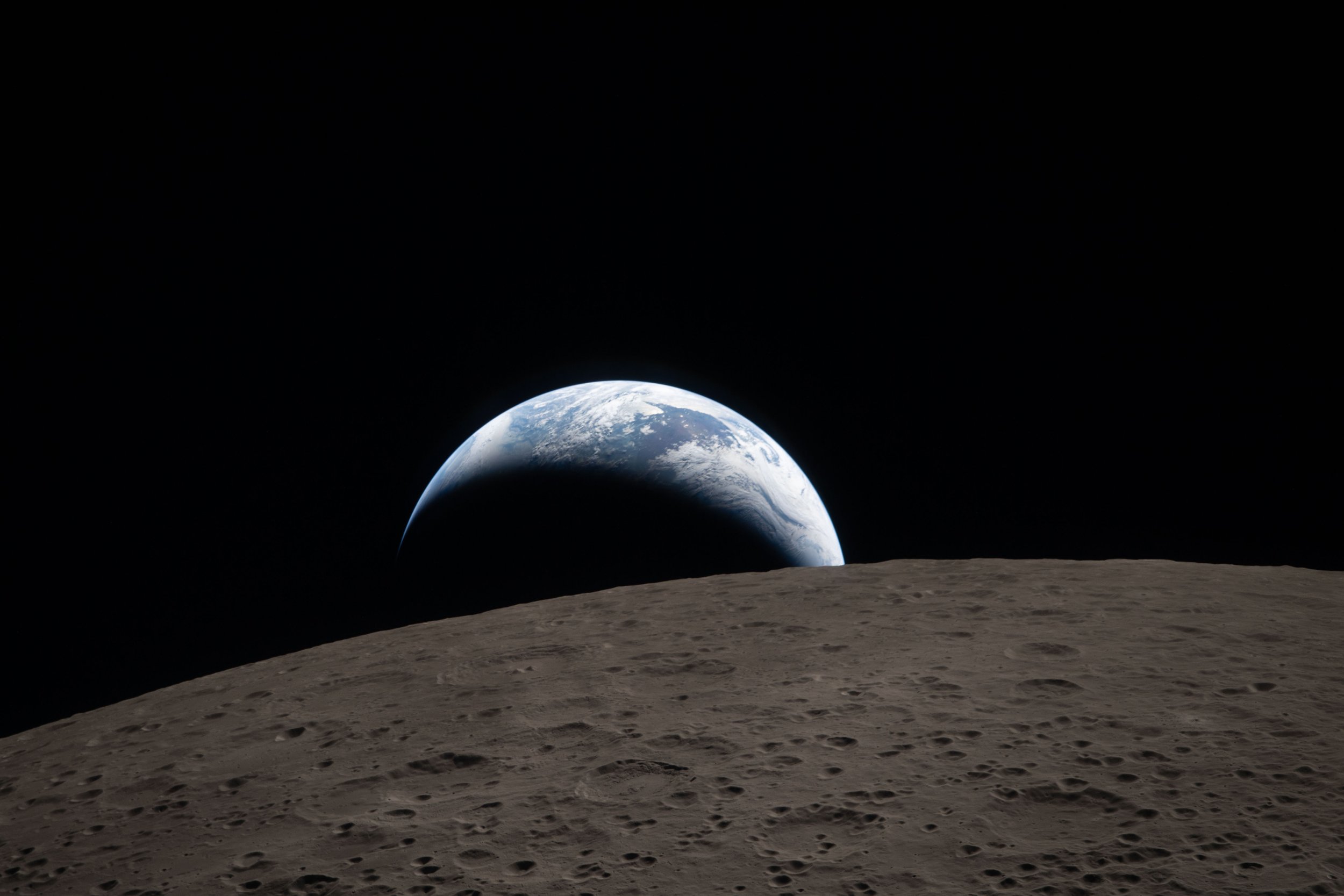
Earthset as captured by the Artemis II crew near the Moon (Courtesy of NASA)
“I would suggest to you that when you look up here, you’re not looking at us. We are a mirror reflecting you. And if you like what you see, then just look a little deeper. This is you.”
On April 10, 2026, the Orion spacecraft carrying Reid Wiseman, Victor Glover, Christina Koch, and Jeremy Hansen came home, splashing down off the coast of, my home, America’s finest city after a nearly ten-day mission around the Moon. The mission took the crew roughly a quarter of a million miles from Earth. At its farthest point, they were farther from home than anyone else had ever gone.
While I’ve already written about what Artemis II means for the SLS Program, and about the larger reshuffling still happening inside the Artemis architecture, what I want to focus on today is something more nuanced and, to my surprise, maybe even more important: It is the way Artemis II slipped into ordinary life; into couches, kitchens, group chats, lunch breaks, and family conversations among people who, during most weeks, aren’t even thinking about Outer Space at all.
That was the part I did not expect… but maybe I should have.
A Surprising Kind of Attention
One of my friends is a primary care doctor. Her days are full of actual human problems: aching shoulders, strange lab results, worried families, and the steady stream of small emergencies that make up ordinary medicine. Outer Space is not exactly on her daily list of concerns. I would never have guessed that she would be texting me about NASA mission timing, or asking about the difference between a launch window and a launch time.
Then Artemis II happened. And there she was, asking questions with the kind of unfiltered kid-like curiosity adults tend to lose somewhere among the daily grind of being responsible for things. Something about that rocket, that crew, and that loop around the Moon had caught her. It would not let go.
She was not alone.
Another friend told me her nephew now wants to be an astronaut. He watched the April 1 launch, and somewhere around liftoff he told his parents that he wanted to do that exact thing: the rocket thing, with the people inside it.
These moments stopped me for a second. It made me think, in a small way, of what Apollo must have done to a generation of American kids in the 1960s. Those launches came through living-room televisions and made the Moon feel less like a distant object in the sky and more like a place people might actually go. Maybe even a place someone you knew could go.
I know the Apollo comparison is obvious. Maybe too obvious. But for my generation, it’s not a memory but rather something we inherited from documentaries, grainy footage, and conversations with our elders. With Artemis II, I felt like I was watching that kind of attention arrive in #realtime for the first time in my own life.
The odd thing is that I should have seen it coming.
I have followed Artemis and its precursor programs for almost a decade. I have written about the architectural pivots, the hardware delays, the political bargains, and the uncrewed test flight that made this mission possible. If anyone had asked me whether a successful crewed return to lunar flight would capture public attention, I would have said yes. But I would have hedged. I would have guessed it would last for a news cycle. Maybe two.
That seemed reasonable. After all, the first crewed launch of the Commercial Crew Program was, by every objective measure, a major milestone. It was the first time American astronauts had launched from American soil since the Space Shuttle retired. It earned a special report, but then by dinner time, much of the country had moved on.
Yet somehow, Artemis II was different, significantly so. Not just bigger but stickier. It stayed in the room longer: the launch felt like an event, and the splashdown felt like a homecoming. NPR described the reaction as nationwide, with stadium Jumbotrons and ordinary viewers pulled into the same moment.
That’s what shocked me. A Starship test flight can earn a C-block mention and some B-roll, and among space people it can dominate the conversation for days. But an Artemis II splashdown could completely take over a Friday night, and not just for the space community. It reached people who don’t know the difference between Orion and Dragon, and who likely don’t care to learn it unless the right story gives them a reason.
And so in this way, Artemis II clarified something for me: the kind of attention that pulls a whole country into the same moment is, even now, something only a public space agency can reliably produce. It can pull a primary care doctor and a curious kid into the same conversation. Even in this commercial era of Outer Space, that unifying job is still NASA’s to do.
What Only a Public Agency Can Do
Don’t get me wrong. The commercial sector has a significant role to play in humanity’s future in Outer Space. Nothing in this blog post is an argument against that fact. SpaceX has changed expectations around what an orbital launch should cost and how often it should fly. Blue Origin is building systems that will matter in the next phase of Artemis. ULA remains one of the quiet workhorses of American launch, and is now positioned to carry the Centaur V into the lunar architecture. There are countless other commercial companies and startups in the wing as well (Rocket Lab, Firefly, Vast, Axiom Space, Relativity Space, Portal, Starfish, Star Catcher, Aetherflux, Planet, LeoLabs, Redwire, Intuitive Machines, Infleqtion, and those are just the ones on the top of my mind and the list goes on…).
Thus, commercial space is not the villain in this story. In many ways, it is the tool that makes the next chapter of human exploration possible. I have written that argument before, and I still fundamentally believe it.
My point here is narrower, and it focuses on the other side of the coin. That there are things a public space agency can do that a private company, however innovative or visionary, cannot quite replicate. Not because these companies lack technical capability, but because they lack a public mandate. A company can inspire. A company can run a flawless livestream. A company can even build a real #fandom. But a company is not designed to turn a national achievement into a public commons.
NASA was created with that public purpose in mind. The National Aeronautics and Space Act of 1958 declared that American activities in Outer Space “should be devoted to peaceful purposes for the benefit of all mankind.” That creed is not just ceremonial language. It shows up in concrete places.
One of those places is imagery. A schoolteacher in Nebraska can pull an Artemis II image into a Monday morning slide deck without phoning a licensing department; a local newspaper can run the splashdown photo on the front page; and a blogger like me can build a post around Earthset, credit NASA, and get on with thinking about what the image means.
And that matters. When the Artemis II crew released Earthset, the image did not become premium content locked behind a platform or a brand asset guarded by a watermark. It became a shared visual inheritance. Classrooms, newspapers, social feeds, and weird little space law and policy blogs could all hold the same picture up to the light.
Commercial operators have every right to protect their imagery, their trademarks, and their brand. I am not annoyed at any of them for doing so. But the thing a public space agency produces, almost as a byproduct of doing its job, is a public commons. Multiplied across decades of missions, those small acts add up to one of NASA’s most underpriced contributions: not just rockets and spacecrafts, not just data and science, but a public visual archive of wonders that anyone can pull without asking for permission.
That kind of value does not show up as revenue. It does not fit neatly into a budgetary spreadsheet. But it is part of what the public is buying.
And the image archive is only one piece of what a public mandate can produce. The bigger piece is what Artemis II just did to a Friday night news cycle. It gave millions of people a reason to stop, point, text a friend, call over a child, or look up from dinner and care about the same thing at the same time.
A Crater Called Carroll
There is another thing a public space agency can do, and Artemis II showed it to me in a way I didn’t see coming.
During the lunar flyby, Mission Specialist Jeremy Hansen, speaking on behalf of the crew, proposed names for two previously unknown small lunar craters. One was Integrity, after the Orion spacecraft. The other was Carroll.
Carroll Crater was inspired by Carroll Taylor Wiseman, Commander Reid Wiseman’s late wife. Carroll died of cancer in 2020 after a five-year battle. She was forty-six, a pediatric nurse practitioner and the mother of two daughters. The crater name still has to go through the International Astronomical Union—because even honors eventually has paperwork. But emotionally, the permanence had already arrived the moment the words were broadcast out of the spacecraft.
Wiseman put out a hand. Koch wiped tears. The four floated together for a long hug, and a lot of people watching cried with them.
On paper, a crater naming is a small bureaucratic thing. Coordinates, designation, review, approval. But what made the moment special was that four astronauts, flying a public mission aboard a publicly-owned spacecraft launched by a publicly funded rocket, used a quiet minute of public airtime to put a moment of private, yet profoundly relatable, human emotion into the permanent public record of the Moon.
That is a thing only a public space agency can do with the type of dignity that this moment deserves.
I do not say that as a dig at private companies. A commercial operator could certainly honor someone. But the institutional context changes the meaning of the gesture. In a commercial setting, the same moment would almost inevitably have to pass through brand calculation (I have seen this in person). Someone would ask how it reads. Someone would ask whether it belongs in the rollout. Someone would worry that it looks like content that the company can’t control.
NASA’s moment landed differently because it was not selling anything. It was not a brand activation. It was a public mission carrying the fact that astronauts are not symbols first. They are spouses, parents, sons, daughters, relatives, friends, co-workers, neighbors, and people who carry grief, and by extension what it means to be human, with them even when they leave the planet.
And in this way, Hansen’s announcement was less about leaving Earth than about bringing its human inhabitants, with all of our emotional heritage, along.
In that minute, NASA did something that the commercial industry is not equipped to do. It carried our marriages and joys, funerals and sadness, and all the ordinary sauce of being human into a frame normally reserved for the cosmos. It invited us to see a place in the universe that would otherwise feel vast and devoid of humanity as somewhere touched by human feeling and memory.
Commercial operators may one day put more humans into Outer Space than NASA ever will. I hope they do. But getting humans into Outer Space is not quite the same thing as extending the human experience beyond Earth. One task is transportation. The other is both cultural and emotional: taking a realm that feels inhuman and remote, and making it something we can emotionally recognize and perhaps one day inhabit. The first task is increasingly commercial. The second still belongs to a public space agency.
This is not because commercial spaceflight lacks human ambition, but because its central relationship is transactional. Meanwhile, NASA’s relationship to Outer Space, when done right, is civic. It does not merely sell access to this space, but through these public missions and experiences like how the Carroll Carter came about, it gives the public a way to see itself there.
One Line Item I Am Glad to Pay For
I pay federal taxes. Like everyone else, I am sometimes annoyed by the waste, inefficiency, and strange compromises that come with how those taxes are spent. NASA is not perfect either. The SLS Saga exists for a reason. The agency can be slow, expensive, political, and frustrating. I don’t think a defense of NASA requires pretending otherwise.
But NASA is still the line item I have the fewest complaints about.
The agency’s fiscal year 2026 budget sits around $25 billion, or roughly a third of one percent of total federal spending. For that price, the United States gets a Moon program that is trying, however messily, to work. It gets a science fleet that stretches across the solar system, a space station still circling above us like a guardian angel, and a media archive that classrooms and curious people can actually use. And, every so often, it gives us a moment when the country looks up from whatever it was doing and cares about the same thing at the same time.
For the first time in a long time, Artemis II delivered that last item. It did so in a way that led to a friend’s nephew deciding he wanted to wear the spacesuit, and a physician friend who normally has zero interest in any of this texting me about it unprompted. If you are keeping a ledger, put those intangibles on the revenue side.
None of this is to argue that NASA should be the end all be all of every Outer Space mission or project. Commercial space entities are already doing many things better than a public space agency can do, and they will keep doing more. And good, they should. The point is not to preserve NASA as the only actor in Outer Space. The point is to preserve the kind of work only a public space actor can do.
The imagery any of us can use, the broadcast anyone can turn on, a crater named for a family member rather than a sponsor. Kids deciding at liftoff that the spacesuits could one day be theirs. A doctor who has patients in the morning but still wants to know how a spacecraft comes home from the Moon.
Those things are not sentimental extras. They are part of why exploration still earns its keep in our uniquely human society.
The SLS Saga will continue, and I will no doubt have more complaints. But when a public space agency succeeds, it brings a value that is not simply a number on a chart. It is the value of unity and curiosity. It is a reminder that a public space agency, funded by all of us (even the rocket industry-bound teenagers who are taxed on their summer job salaries) can still make a whole country look up at once.
And that’s not just a rocket program. It is the mirror Hansen was talking about, and it is the one line item I am glad to pay for as a taxpayer.